Interoperability as a Fundamental Design Pillar
All accessible Spec Resources available to Actors in SafeCDx traverse the network as bytes, are serialized as Protocol Buffers, and modeled as Spec Entities. We use a technique called stereographic projection to project Spec Resources to FHIR resources, or any other binary or text format exchanged on HTTP, HTTP2, MLLP or TCP wire protocols. Projection allows us to use many Open Systems Interconnection (OSI)-session layer framing protocols and nullifies the concern of binding too closely to a single clinical standard such as FHIR, while still gaining the benefits of such a great standard as FHIR.
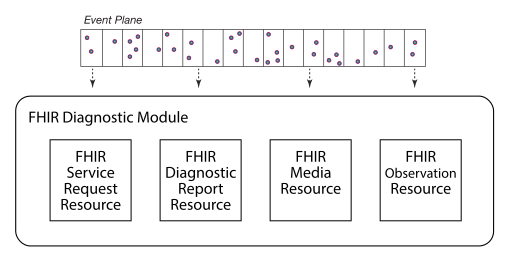
All Diagnostic Spec Resources are projected as FHIR Resources by default and stored in our Health Record Store. Each Connected Test instance can be stereographic projection wherever the originating data source is located using pluggable Connectors. For example, if the original source of a Connected Test stems from a Physical Point of Care encounter, the system can project back to that EHR. This is also the case for a digital health app, or a telehealth platform consultation such as Teledoc or Amwell.
By using the FHIR clinical exchange standard, SafeCDx is natively interoperable with legacy systems and coding standards. This allows us to be interoperable with nomenclature and coding databases, while our approach allows for rapid evolution as new standard boards form.