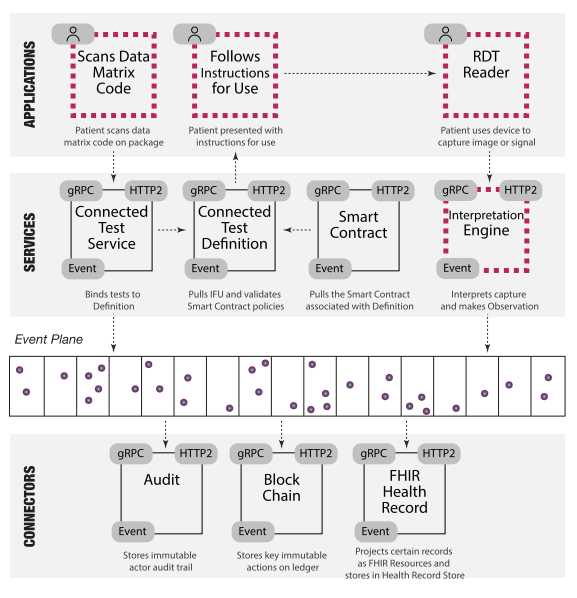
How a Connected Test Transaction Works
Here we show a simplified diagram that is a hybrid between a process and a logical diagram. Below we describe how a distributed Connected Test transaction works at a high-level, and identify what items are swappable in the pink dotted lines:
- A Patient first acquires a Test at a local pharmacy or grocery store, then has it delivered via FedEx or DoorDash.
- The Patient needs to register the Test on the platform and therefore scans the data matrix code which contains a unique ID of the test, using a supported Mobile Solution Application.
- The system identifies the Test and binds it to a Connected Test Definition.
- From the Definition, the system: (1) pulls the Instructions for Use (IFU) and timer scenarios; (2) binds this Test instance to a Smart Contract; (3) identifies the Rapid Diagnostic Test (RDT) reader capture modalities; and (4) validates invariant conditions are met based on the policies defined within the Smart Contract. These steps drive logic for use and availability of the Test.
- With all pre-conditions, policies, use-cases, and Patient eligibility validated, the system presents the Patient with a set of collection instructions.
- The system is now ready to capture signals from the pluggable Digital RDT reader. Signals can be in the form of image capture, video capture, or Bluetooth paired signal capture. RDT readers are pluggable based on vendor and are transaction aware. For example, a single transaction can use RDT reader one, but another transaction can use RDT reader two.
- Once an RDT read is complete, the system sends a CDx Spec Event that our swappable Interpretation engine intercepts. The default Interpretation engine uses deep and machine learning to result the Test (make an observation). This observation is projected as a FHIR Observation Resource. The Interpretation engine provides an interface that allows third parties to plug in their own Interpretation engine that are FDA approved.
- A pointer to the Resulted Connected Tests is placed immutably on the block chain bound by the UID of the device and the Patient ID. The Block chain record also identifies the ordering provider, a pointer to the Connected Test Definition, and the relevant data for the Test.
- Data access is also based on Smart Contracts which drive the Consent logic and governs who can access the data and for how long.